
Walk into any home where art is chosen with intention, and there's a good chance you'll find something that stops you mid-step. A painting where every inch breathes. Where fish swim between lotus petals. Where gods and goddesses stare back at you with wide, knowing eyes framed in bold black lines.
That is Madhubani painting.
It is one of India's oldest and most celebrated folk art traditions — born not in an academy or a studio, but on the walls of humble homes in the Mithila region of Bihar. For centuries, it was a woman's art. Passed quietly from mother to daughter, painted at weddings, drawn to mark the arrival of a new season, offered as prayer made visible.
Today, Madhubani painting has travelled from those earthen walls to international galleries, to the canvases of global collectors, and to the fabric of sarees worn by women who want to carry a piece of that history with them. Yet despite its fame, many people still ask the same simple question: what exactly is Madhubani painting, and where does it come from?
This post answers that — thoroughly.
What Is Madhubani Painting?
Madhubani painting, also known as Mithila painting, is a traditional Indian folk art that originates from the Mithila region of Bihar in northern India. The name comes directly from the district of Madhubani — madhu meaning honey and bani meaning forest — a region known for its deep cultural and spiritual heritage.
At its core, Madhubani is a two-dimensional art form defined by:
- Bold, confident outlines drawn in black
- Vivid, flat colours filling every section with no shading or perspective
- Zero empty space — the entire surface is packed with motifs, patterns, and borders
- Symbolic imagery drawn from nature, mythology, and daily life
Unlike most art traditions that evolved through formal institutions, Madhubani was entirely domestic and oral in its transmission. Women of the Mithila community created these paintings on freshly plastered mud walls and floors of their homes (kohbar ghar) — the bridal chamber — as an act of blessing, prayer, and celebration.
It is not just art. It is a visual language.
The History and Origins of Madhubani Painting
Ancient Roots in Mithila
The origins of Madhubani art are ancient, with many scholars tracing its roots back over 2,500 years. The earliest literary reference comes from the Ramayana itself — King Janaka of Mithila (father of Sita) is said to have commissioned paintings to decorate his kingdom for the wedding of Sita and Lord Ram. This places Madhubani art at the very heart of one of India's foundational epics.
For most of its history, Madhubani painting was not meant to be preserved. It was painted on walls and floors that would eventually be replastered. The art was cyclical — created, worn away, and repainted — living in the rhythm of the seasons, festivals, and life events of the community.
The 1966 Drought: The Turning Point
The modern journey of Madhubani art began with a crisis. In 1966–67, a severe drought devastated Bihar. The Indian government sent officers to assess the damage and explore relief measures.
One of those officers was William G. Archer, a British civil servant and art lover who had encountered Madhubani murals in 1934 during an earthquake relief effort. He was struck by what he saw and encouraged the women of Mithila to paint on paper and canvas so that their art could be sold beyond their village walls.
This single intervention changed everything. Women who had only ever painted for ritual and prayer began painting for an audience. Their art found its way to exhibitions in Delhi, and soon to galleries abroad. What was once invisible to the outside world became internationally celebrated almost overnight.
GI Tag Recognition
In 2007, Madhubani painting received a Geographical Indication (GI) tag from the Government of India — one of the most important official recognitions a craft tradition can receive. The GI tag certifies that only paintings made by artists from the Mithila region of Bihar can be officially called "Madhubani paintings."
This recognition was not just ceremonial. It protects the livelihoods of thousands of artisan families, preserves the authenticity of the craft, and gives consumers a way to verify that what they are buying is the real thing.
The Five Styles of Madhubani Painting
One of the most misunderstood aspects of Madhubani art is that it is not a single unified style. Within the tradition, there are five distinct sub-styles, each historically associated with different communities and purposes in Mithila society.
1. Bharni
The Bharni style is characterised by bold, solid fills of bright colour inside thick black outlines. It was traditionally practised by the Brahmin and Kayastha communities and focused heavily on religious themes — depictions of gods and goddesses, divine narratives, and sacred symbols. The filling of colour is dense and vibrant, with a strong visual punch.
2. Katchni
Katchni work is finer and more delicate. Rather than solid colour fills, Katchni artists create texture and depth using intricate lines and cross-hatching within the outlined shapes. It is slow, meticulous work and is often considered the most technically demanding of the Madhubani styles.
3. Tantrik
Rooted in Tantric traditions and spiritual practice, this style uses sacred geometric symbols, yantras, and imagery from Shakti worship. It has a more meditative, esoteric quality and is less commonly seen in commercial Madhubani art today.
4. Godna
Godna refers to the traditional tattooing practice of lower-caste women in Mithila, and this painting style replicates those tattoo patterns — geometric, repetitive, and earthy. It is one of the most distinctive and visually striking Madhubani styles, with a rawness that sets it apart.
5. Kohbar
Kohbar paintings are specifically associated with wedding rituals. They are made in the kohbar ghar — the bridal chamber — and are filled with fertility symbols: bamboo groves, lotus flowers, fish, birds, and the intertwining of male and female cosmic forces. Kohbar is where Madhubani painting began, in its most sacred and intimate form.
Common Motifs and Their Meanings
Every element in a Madhubani painting carries meaning. Nothing is random. Understanding the symbolism transforms the experience of looking at this art from appreciation to comprehension.
Fish — considered sacred in Mithila, fish represent fertility, good luck, and prosperity. They are one of the most frequently appearing motifs across all Madhubani styles.
Lotus — the lotus symbolises purity, divine beauty, and spiritual awakening. It appears as a border, a backdrop for deities, and as a standalone motif.
Peacock — representing love, beauty, and the arrival of the monsoon. Often depicted in pairs to symbolise romantic union.
Sun and Moon — cosmic symbols representing the eternal cycle of time, life, and the universe. Almost always present in religious Madhubani compositions.
Bamboo — particularly in Kohbar paintings, bamboo groves represent fertility and the sacred bond of marriage.
Serpent (Nag) — associated with protection, fertility, and Shiva. Often found guarding sacred spaces within the painting.
Hindu Deities — Krishna, Rama, Sita, Durga, Lakshmi, and Saraswati are frequent subjects, depicted in their divine narratives and surrounded by their associated symbols.
Geometric borders — every Madhubani painting is enclosed in elaborate geometric borders that define the sacred space of the image, much like a temple's boundary wall.
Materials and Techniques: How Madhubani Art Is Made
The process of creating an authentic Madhubani painting is itself a deeply considered act, rooted in the materials available in the natural world.
Traditional Materials
Surface: Originally plastered mud walls or floors. Over time, this evolved to aripan (rice paste on floors), handmade paper, silk, and cotton fabric.
Pigments: Traditional Madhubani artists used entirely natural dyes:
- Black from lampblack (soot) or charred rice
- Red from the kusum flower or sandalwood
- Yellow from turmeric or pollen
- Green from leaves, especially bilva (bel)
- White from rice paste
- Blue from indigo
Brushes and tools: Twigs chewed at the end to form a brush, cotton wrapped around a stick, fingers, and even matchsticks were the original tools. Each gave a slightly different quality of line.
Contemporary Practice
Today, most Madhubani artists work on paper or canvas using a combination of traditional natural dyes and commercial poster/acrylic colours. The fundamental techniques — the bold outline, the flat fill, the dense patterning — remain unchanged. What has changed is the scale of production and the range of surfaces: Madhubani motifs now appear on sarees, stoles, lampshades, wall hangings, cushion covers, and more.
Madhubani on Fabric: Where Art Meets Wearability
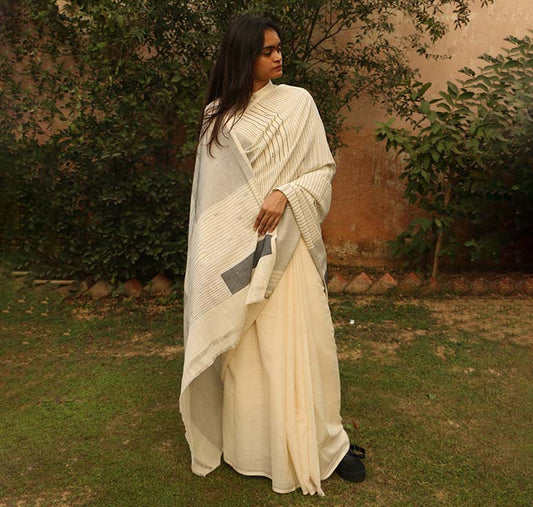
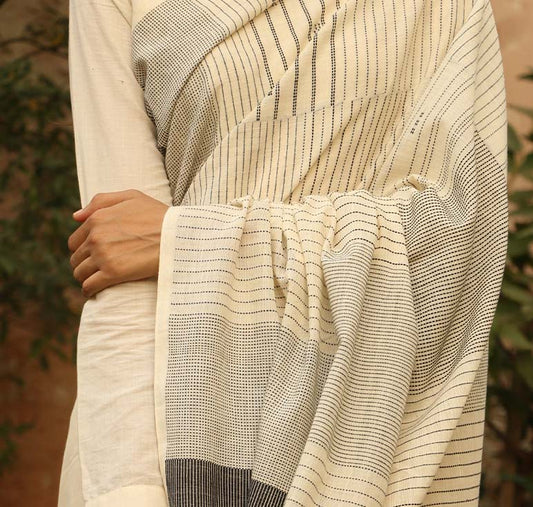
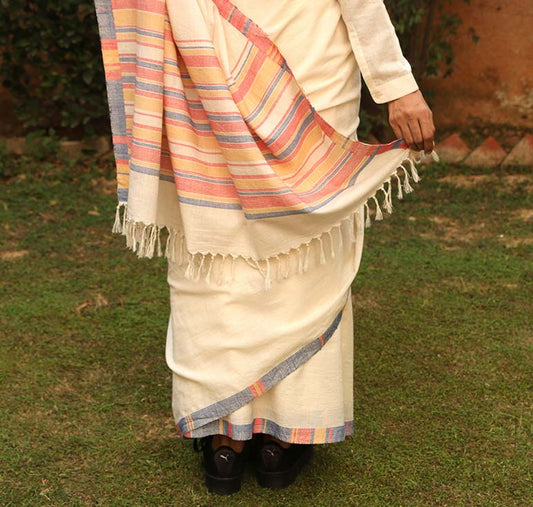
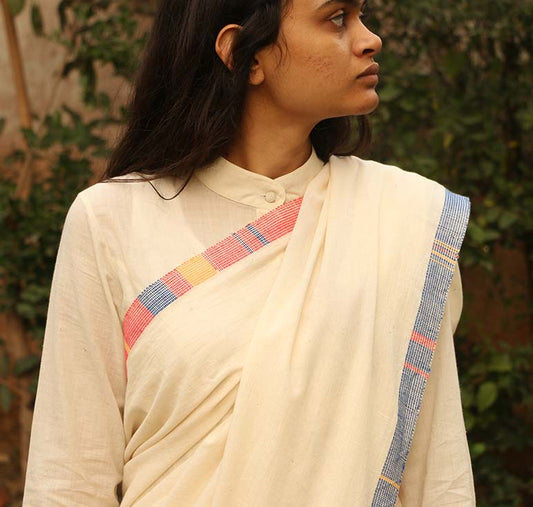
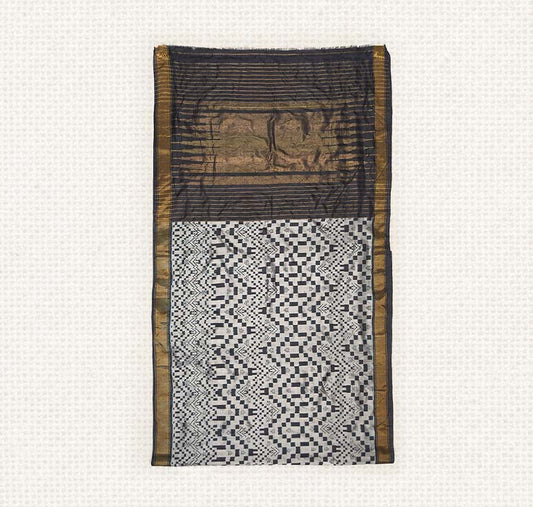
One of the most significant developments in the modern life of Madhubani art is its migration onto textiles. When the same fish, lotus, and deity motifs that once adorned wedding chamber walls are woven or hand-painted onto a saree, something remarkable happens — the wearer carries the story.
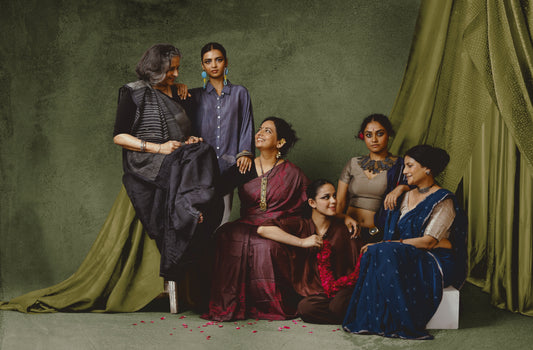
Madhubani textiles — particularly sarees and stoles — have become one of the most sought-after expressions of Indian craft heritage. They appeal to women who want their clothing to mean something. Who want the art on their body to have a history, a geography, a maker behind it.
At Jiyo, our Madhubani collection is made in collaboration with artisans from the Mithila region, ensuring that every piece you wear is rooted in authentic craft tradition. Each saree carries motifs that have been passed down through generations — not mass-produced imitations, but genuine expressions of a living art form.
Why Madhubani Painting Matters Beyond Its Beauty
Preservation of Living Heritage
Madhubani painting is not a museum artefact. It is a living tradition — one that continues to evolve, absorb new themes, and find new surfaces. Contemporary Madhubani artists have depicted social issues, environmental concerns, and modern life alongside the timeless motifs of fish and lotus. The tradition is alive precisely because it is not frozen.
Economic Empowerment of Women Artisans
For thousands of women in Mithila, Madhubani painting is not a hobby. It is a livelihood. The commercialisation of Madhubani art — however contentious it may sometimes be — has given women artisans economic independence and recognition within their communities. Buying authentic Madhubani art directly supports these women and the communities they sustain.
A Counter to Mass Production
In an age of identical products manufactured in bulk, Madhubani painting stands for the opposite. Every piece is unique. Every artist brings her own hand, her own interpretation, her own life experience to the canvas. You cannot mass-produce Madhubani. Its value is inseparable from its handmade nature.
Topical Authority in Indian Craft Education
Institutions like the Asian Heritage Foundation (AHF) — the organisation behind Jiyo — have long worked to document, promote, and sustain traditions like Madhubani. When you engage with Madhubani art, you are participating in a broader ecosystem of cultural preservation that stretches from rural Bihar to international art fairs.
How to Identify Authentic Madhubani Painting
With the rise in popularity has come an inevitable rise in imitation. Here is what to look for when buying authentic Madhubani art:
- Artist's name and origin — genuine Madhubani artists are proud of their heritage. Look for work that names the artist and specifies Mithila, Bihar as the origin.
- GI tag certification — for high-value pieces, ask for documentation of the GI tag.
- Natural dye signatures — authentic pieces often have the slight variations in colour depth that come from natural dyes. Perfect, uniform colour may indicate industrial printing.
- No empty space — real Madhubani fills every corner. Large undecorated areas are a red flag.
- Hand-drawn lines — look closely at the outlines. Hand-drawn lines have natural variation; printed lines are mechanically uniform.
- Buy from verified sources — platforms and stores directly connected to artisan communities, like Jiyo's Madhubani collection, provide authenticity by design.
Conclusion
Madhubani painting is not simply an art form. It is a record. A living archive of mythology, faith, ecology, womanhood, and community — told in fish and lotus and bold black lines by generations of women who never needed a gallery to validate their vision.
When you understand Madhubani painting, you understand something important about how culture survives: not through institutions, but through hands. Through the act of one woman teaching another. Through paint applied to a wall before a wedding. Through a tradition that refused to be forgotten even when no one outside of Bihar was watching.
That is why, at Jiyo, we do not just sell Madhubani products. We tell the story behind them. Because the story is what gives the art its value — and what makes choosing handmade a genuinely meaningful act.
Frequently Asked Questions (FAQ's)
Q1. What is the difference between Madhubani and Mithila painting?
They are the same art form. "Mithila painting" refers to the geographic region of origin (Mithila in Bihar), while "Madhubani painting" refers to the district name. Both terms are used interchangeably.
Q2. Is Madhubani painting only religious?
No. While religious themes dominate traditional Madhubani, contemporary artists also depict nature, social issues, weddings, seasons, and everyday life. The style is the constant; the subject matter evolves.
Q3. Can Madhubani motifs appear on fabric?
Absolutely — and increasingly so. Madhubani motifs are painted directly onto silk and cotton fabrics, or woven into sarees by artisans trained in both the painting tradition and textile craft.
Q4. Who are the most famous Madhubani artists?
Sita Devi, Ganga Devi, Bharti Dayal, and Baua Devi are among the most celebrated names. Baua Devi was awarded the Padma Shri by the Government of India for her contribution to Madhubani art.
Q5. Where can I buy authentic Madhubani products?
Look for stores directly sourcing from Mithila artisans. Jiyo's Madhubani collection features pieces made in collaboration with Bihar-based craftspeople, ensuring authenticity and fair trade.
Tags: